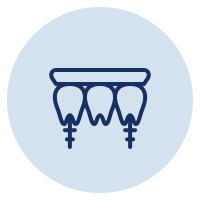
What Is an Implant-Supported Dental Bridge?
An implant-supported bridge is a fixed restoration supported by two or more dental implants placed in the jawbone. The implants act as artificial tooth roots. After healing, a series of connected dental crowns is secured to the implants, replacing the missing teeth between them and restoring function and stability.
Unlike a traditional bridge that depends on adjacent teeth for support, an implant-supported dental bridge is designed to stand on its own foundation. This can improve stability and reduce stress on surrounding teeth.
Implant-Supported Dental Bridge Process
Treatment is typically completed in stages to support proper healing and long-term stability.
- Implant placement: Dental implants are placed in the jawbone in the area of missing teeth. If additional support is needed, bone grafting may be recommended to help rebuild or strengthen the foundation before or during implant placement.
- Healing and osseointegration: Over the following months, the jawbone bonds to the implants through a process called osseointegration. This creates a stable base for the final bridge.
- Final restoration: Once healing is complete, your restorative dentist places the final bridge. We coordinate with the restoring provider in most cases to keep treatment planning efficient.
Recovery and Healing
Recovery varies depending on the number of implants placed and whether additional procedures are involved. Most patients experience mild swelling and soreness that improves over several days.
In appropriate cases, platelet-rich fibrin (PRF) may be used to support healing. PRF is created from the patient’s own blood and placed at the surgical site to promote natural tissue repair.
Healing time before the final bridge is placed typically ranges from three to six months, allowing the implants to fully integrate with the bone. Clear aftercare instructions and ongoing support are provided throughout the healing process.
Did You Know?
Because implant supported dental bridges are secured to implants rather than removable components, many patients report that the bridge feels stable during normal chewing and speaking once healing is complete. This fixed design can make daily activities feel more natural compared to removable options.
Advanced Implant Technology and Techniques
Treatment planning plays an important role in implant success. Our practice uses advanced imaging and guided planning tools to tailor care to each patient’s anatomy and goals.
X-Guide Guided Implant Placement
X-Guide uses real-time 3D navigation to guide implant placement with a high level of accuracy. This supports precise positioning while minimizing disruption to surrounding tissue.
Bone Grafting and Foundation Support
If the jawbone needs additional support, bone grafting may be recommended to rebuild the foundation before or during implant placement. Treatment is planned with a minimally invasive mindset whenever possible, with grafting materials selected based on the clinical needs of the site.
Immediate Implant Placement
In select cases, implants can be placed at the same time as a tooth extraction. When appropriate, this can reduce the number of procedures and help preserve bone and gum tissue.
Why Choose an Oral Surgeon for Implant-Supported Dental Bridge Care?
Dental implant surgery requires advanced training, careful intraoperative decision-making, and a detailed understanding of jawbone anatomy. An oral surgeon is trained to manage bone quality, complex anatomy, and surgical variables that can impact long-term implant stability.
At Offshore Oral & Facial Surgery, Dr. Drake Exstrom focuses on outcome-driven care using the least invasive approach appropriate for each patient. Surgical planning and technique are guided by the goal of supporting predictable healing and long-term implant success.
Dental Insurance and Payment Options
Insurance coverage varies by plan and by patient. We are in-network with the majority of insurance providers to help estimate available benefits, but coverage verification does not guarantee payment. Treatment fees are reviewed during your consultation so you have a clear understanding of expected costs.
FAQs
How many teeth can be on an implant-supported bridge?
An implant-supported bridge can replace several missing teeth in a row. The exact number depends on the location of the bridge, bite forces, bone support, and how many implants are placed.
What is the life expectancy of an implant-supported bridge?
With proper planning, good oral hygiene, and regular dental care, an implant-supported bridge is designed to be a long-term solution. The implants themselves can last many years, while the bridge may require maintenance or replacement over time due to normal wear.
What are the cons of an implant-supported bridge?
An implant-supported bridge requires surgery and a healing period before the final restoration is placed. Treatment time is longer than that of a traditional bridge, and not every patient is a candidate. Some patients may require additional procedures such as bone grafting.
What maintenance is required to care for an implant-supported dental bridge?
Daily brushing and flossing are essential, along with regular dental cleanings and exams. Special flossing tools or interdental cleaners may be recommended to clean beneath the bridge. Dr. Drake Exstrom likes to make the analogy of a new car. In order to maintain the longevity of the new car, ongoing maintenance like waterpik, flossing, brushing well, and other adjuncts help support gum health and long-term implant stability.
Where can I get an implant-supported bridge in North County San Diego?
Offshore Oral & Facial Surgery provides implant-supported bridge treatment at our San Marcos and Vista offices. Contact us to schedule a consultation and learn about your treatment options.