
Wisdom teeth do not always grow straight into an open space. One may lean forward, lie sideways, or remain hidden beneath the gums or jawbone. Learning how impacted wisdom teeth are classified can make it easier to understand what is happening and what treatment may involve.
Table of Contents
How Impacted Wisdom Teeth Are Classified
An impacted wisdom tooth is a third molar that cannot fully grow into its expected position. This often happens because there is not enough room at the back of the jaw.
There are two main ways to describe an impaction:
- Angle: The direction the wisdom tooth points within the jaw.
- Depth: Whether gum tissue, bone, or both cover the tooth.
This means one tooth can have two classifications. For example, an X-ray may show a horizontally positioned tooth that is also a complete bony impaction.
The Four Types of Impaction by Angle
The four main classifications by angle are mesial, vertical, horizontal, and distal.
Mesial Impaction
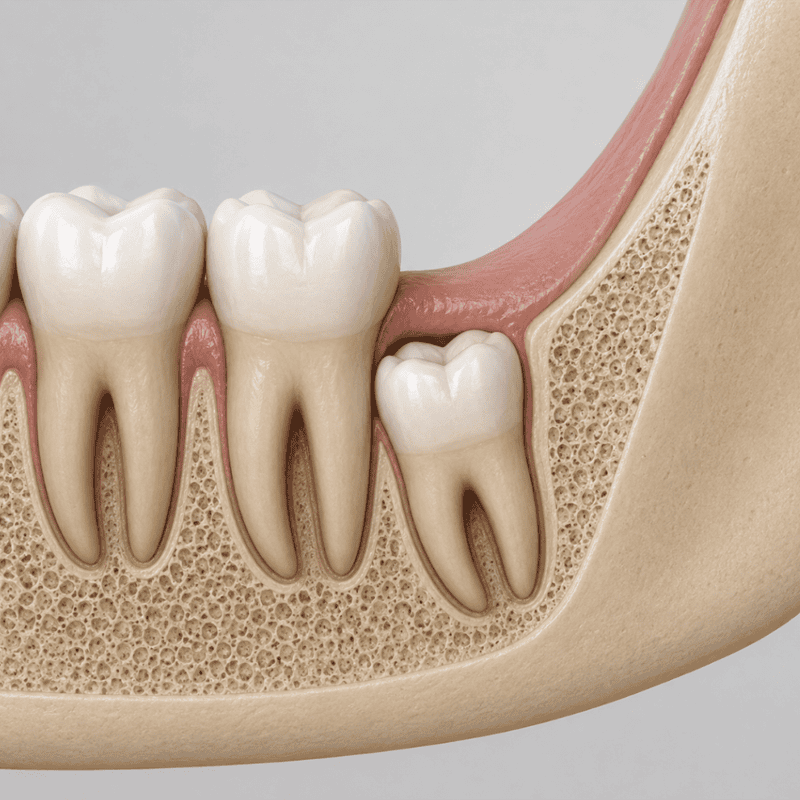
A mesial impaction occurs when the wisdom tooth tilts toward the front of the mouth. Its crown points toward the second molar directly in front of it.
This is the most common wisdom tooth position. The tooth may remain completely trapped or partially break through the gums. When part of it erupts, the angled space between the wisdom tooth and second molar can become difficult to clean.
Food and bacteria may collect in this area, increasing the risk of:
- Gum inflammation around the wisdom tooth
- Decay in the wisdom tooth or second molar
- Infection
- Damage to the neighboring tooth
Vertical Impaction
A vertically impacted wisdom tooth sits mostly upright, similar to the other molars, but remains partly or completely trapped.
The tooth may lack enough room to finish erupting even though it points in the expected direction. Some vertically positioned wisdom teeth remain stable, while others partially emerge and create a gum flap that traps food and bacteria.
Horizontal Impaction
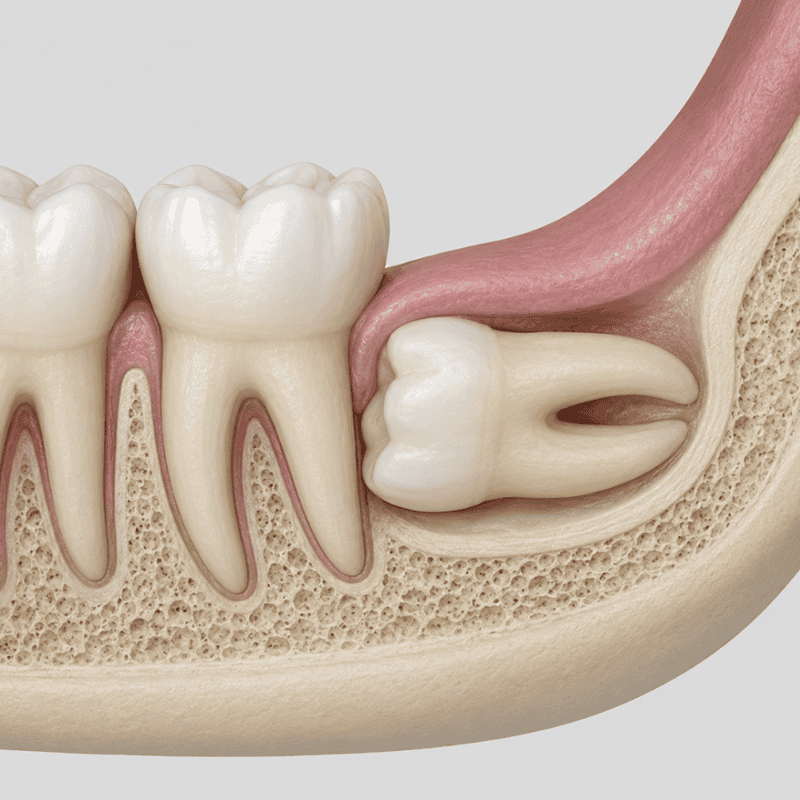
A horizontally impacted wisdom tooth lies on its side. The crown points directly toward the second molar rather than toward the chewing surface.
Because of this position, the wisdom tooth may press against the neighboring tooth or its roots. It can remain completely inside the jawbone, making surgical access more involved than it would be for a fully erupted tooth.
Distal Impaction
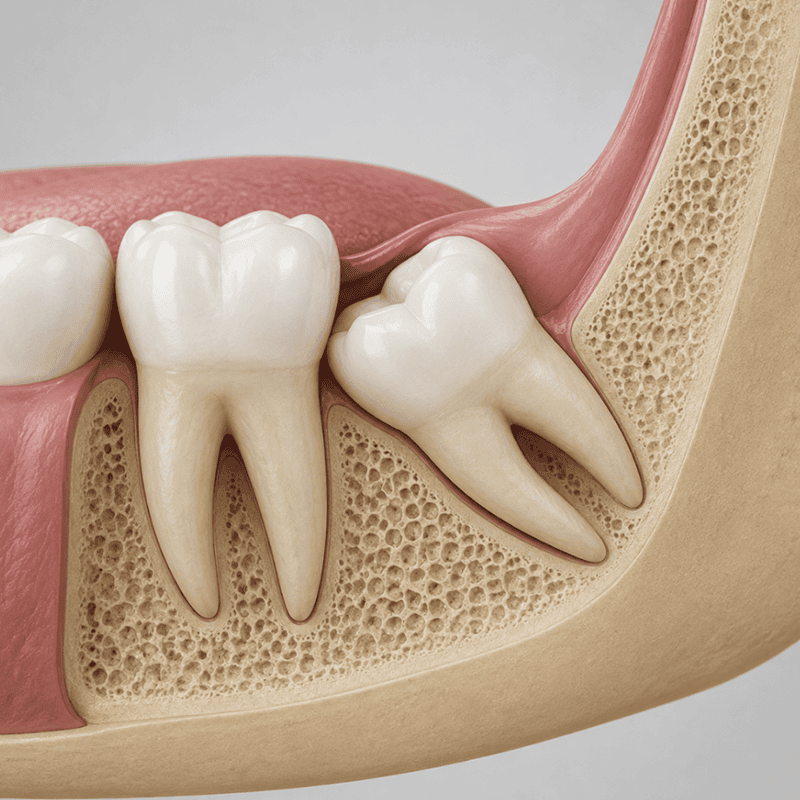
A distal impaction angles toward the back of the mouth, away from the second molar. It is the opposite of a mesial impaction and is the least common of the four positions.
Although the crown points away from the neighboring tooth, the area may still be difficult to clean or may lack room for full eruption. A distal tooth can also remain partly or completely covered by gum tissue and bone.
Soft Tissue and Bony Impactions
Wisdom teeth can also be classified by the tissue covering them. This classification helps explain how deeply a tooth sits and what access may be needed during removal.
Soft Tissue Impaction
A soft tissue impaction has passed through the jawbone but remains partly or completely covered by gum tissue.
A partially visible tooth may leave a flap of gum over the crown. Food and bacteria can collect beneath this flap, making the area sore, swollen, or difficult to clean.
Partial Bony Impaction
A partial bony impaction occurs when part of the wisdom tooth remains covered by jawbone. Another portion of the crown may sit above the bone or become visible through the gums.
Complete Bony Impaction
A complete bony impaction remains fully enclosed within the jawbone. The tooth is not visible in the mouth and may sit upright, angled, or sideways beneath the surface.
How Impaction Type Affects Wisdom Teeth Removal
The angle and depth of an impacted wisdom tooth help determine how it can be removed. However, two teeth with the same classification may require different approaches based on their roots, surrounding bone, and proximity to nearby nerves or sinuses.
Dental X-rays allow Dr. Drake to evaluate the position of each tooth and look for decay, infection, or damage to the neighboring molar. When a more detailed view is needed, CBCT imaging can show the roots, jawbone, and surrounding anatomy in three dimensions.
Do All Impacted Wisdom Teeth Need Removal?
Some impacted wisdom teeth remain healthy, stable, and free from disease. Dr. Drake may recommend monitoring them with regular examinations and updated imaging.
Wisdom teeth removal may be recommended when an impacted tooth causes symptoms or creates a meaningful risk to oral health.
Reasons for removal may include:
- Repeated pain, swelling, or infection
- Decay that is difficult to treat
- Damage to the second molar
- Gum problems around a partially erupted tooth
- Cyst formation or other tissue changes
- A position that is likely to create future problems
FAQs
What is the most common type of wisdom tooth impaction?
Mesial impaction is the most common type. It occurs when the wisdom tooth tilts forward toward the second molar.
What is the most difficult wisdom tooth impaction to remove?
Horizontal and complete bony impactions can require a more involved surgical approach. However, difficulty also depends on root shape, depth, bone density, and the tooth’s proximity to nerves or sinuses.
Can a vertically impacted wisdom tooth erupt normally?
It may continue to erupt if enough space is available, but an upright position does not guarantee this. Imaging can show whether the tooth has room to emerge or is likely to remain trapped.
Is a partially impacted wisdom tooth worse than a fully impacted one?
A partially impacted wisdom tooth may be more likely to develop decay or infection because the exposed area can be difficult to clean. A fully impacted tooth may cause no symptoms, but it can still affect the neighboring tooth or develop other problems beneath the gums. X-rays are needed to determine the risks associated with either type.
Wisdom Teeth Evaluations in San Marcos and Vista, CA
If you have been told that your wisdom teeth are impacted, schedule a consultation with Dr. Drake at Offshore Oral & Facial Surgery. He can review your imaging with you and discuss whether monitoring or removal is the right next step. Book a wisdom teeth consultation at one of our convenient locations in San Marcos or Vista, CA.